
Brown Projected Versus Actual Release
TDCJ defines Projected Release Date as a forecast based on offense and sentence data, statutory eligibility, classification, and credit calculations. It is not proof that a person walked out. A Scheduled Release Date and Scheduled Release Location, when supplied after processing, are closer to an operating plan. They still may change without notice, even on the listed day.
Actual release is a completed event. Brown County's Released detail gives date, time, How Released, and Release Reason. For state custody, later status, TDCJ IVSS, unit confirmation, Review and Release Processing, or a historical record provides better proof than a forecast.
A pretrial detainee has no sentence-based release date. Bond action, court orders, holds, and jail processing control that exit. A bond amount alone does not prove departure.
Find Brown County Release Dates
Choose the source by custodian. TDCJ covers Texas prison and state-jail commitments, including Thomas R. Havins Unit. The sheriff covers local jail stays. Courts hold the judgment, sentence, jail-credit findings, and orders behind the date.
- Identify the facility and whether the person is pretrial or sentenced.
- For TDCJ, search by TDCJ or SID number when known, or use name with optional gender and race.
- Compare identifiers, conviction county, offense, unit, and the exact date label.
- For Brown County Jail, open Released detail or contact records and the correct clerk.
- Confirm a planned exit by phone and later obtain the actual release record.
The TDCJ search says data is updated on working days and is at least 24 hours old. Its captured screen appears below.
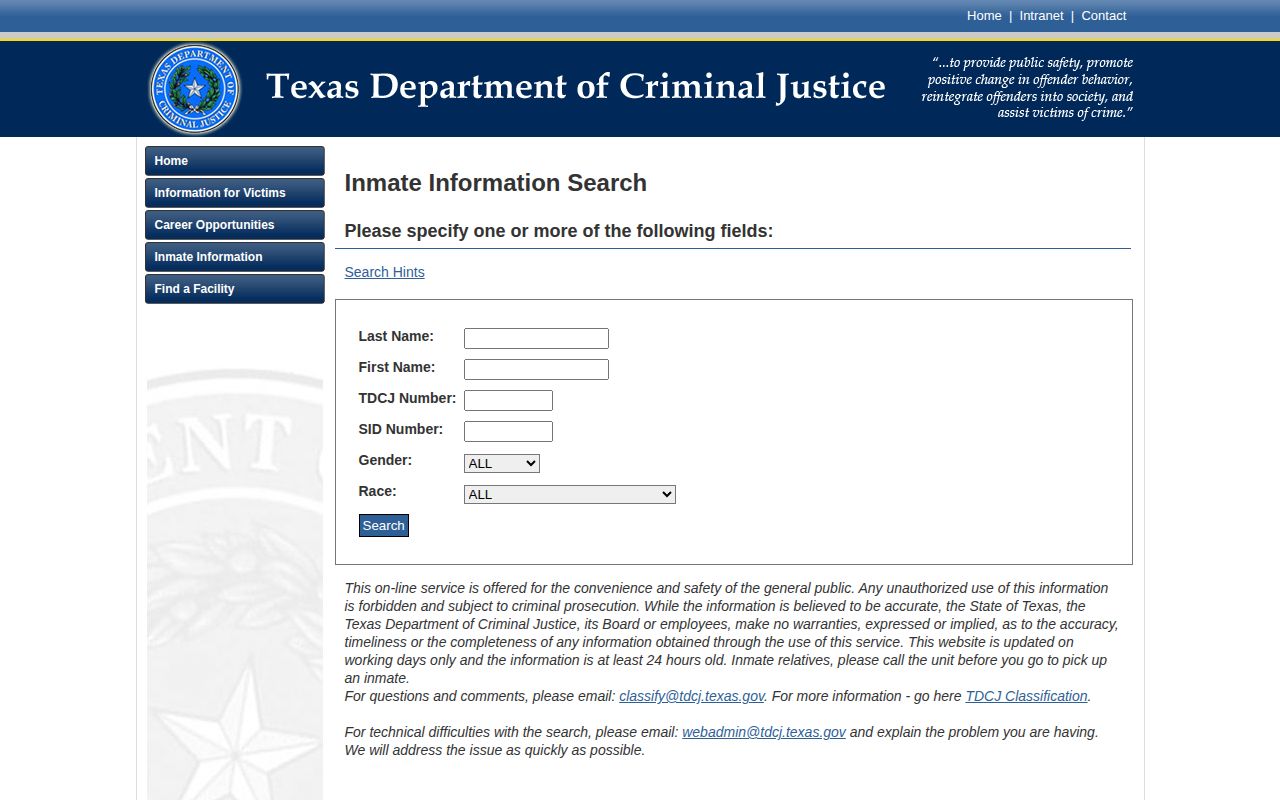
If a discharged person is absent, use TDCJ email or a Public Information Act request. The Brown County release search covers the local path.
Texas Good Time in Brown Cases
Texas Government Code Section 498.003 says good conduct time affects parole or mandatory-supervision eligibility. It does not shorten the judicial sentence and is a privilege. Classification matters. The statute describes 20 days per 30 served for trusty and Class I status, with possible extra trusty credit, 10 per 30 for Class II, and none for Class III.
For an eligible offense before September 1, 1996, TDCJ describes PRD as the point when flat time plus good time equals the sentence. For eligible offenses on or after that date, discretionary approval is also required. A denial can move PRD to maximum expiration, while later approval can move it earlier.
Brown County jail sentences require the judgment, sentence start, jail credit, and sheriff or court confirmation. Do not import TDCJ logic into a local sentence.
No Texas Blanket 85% Rule
Texas does not use one 85-percent rule for all prisoners. Government Code Section 508.145 has offense-specific formulas. The serious-offense group tied to article 42A.054 commonly requires actual calendar time equal to half the sentence or 30 years, whichever is less, with statutory minimums and exceptions. Good time does not replace that calendar time.
Eligibility is not release. A favorable parole vote may remain subject to programs, residence approval, conditions, registration rules, or discipline. Any calculator that ignores the actual offense date and judgment can give a false answer.
Why Brown Release Dates Change
A projected date can move in either direction as the official record changes.
| Factor | Possible effect |
|---|---|
| Classification or discipline | Changes credit and eligibility calculations. |
| Mandatory-supervision decision | Can move PRD toward maximum expiration or earlier. |
| Parole vote | May remain contingent and does not prove departure. |
| Court correction | Changes the legal source data. |
| Detainer or hold | May turn release into transfer. |
| Update lag | The web page may trail agency records. |
An ICE detainer does not itself prove transfer or deportation. Confirm any receiving authority named in the record.
Confirm Brown County Actual Release
For free TDCJ information, email pia@tdcj.texas.gov with full name and TDCJ number. If unknown, provide birth date or approximate age and conviction county. Ask for the official Projected Release Date field. For an old event, request public incarceration history, actual release or discharge date, type, and release documents.
For Brown County Jail, email sheriff.records@browncountytx.gov and identify the person, booking range, and exact release fields. The sheriff record proves the exit; the court record explains the case.
The TDCJ definitions page explains PRD and appears below.
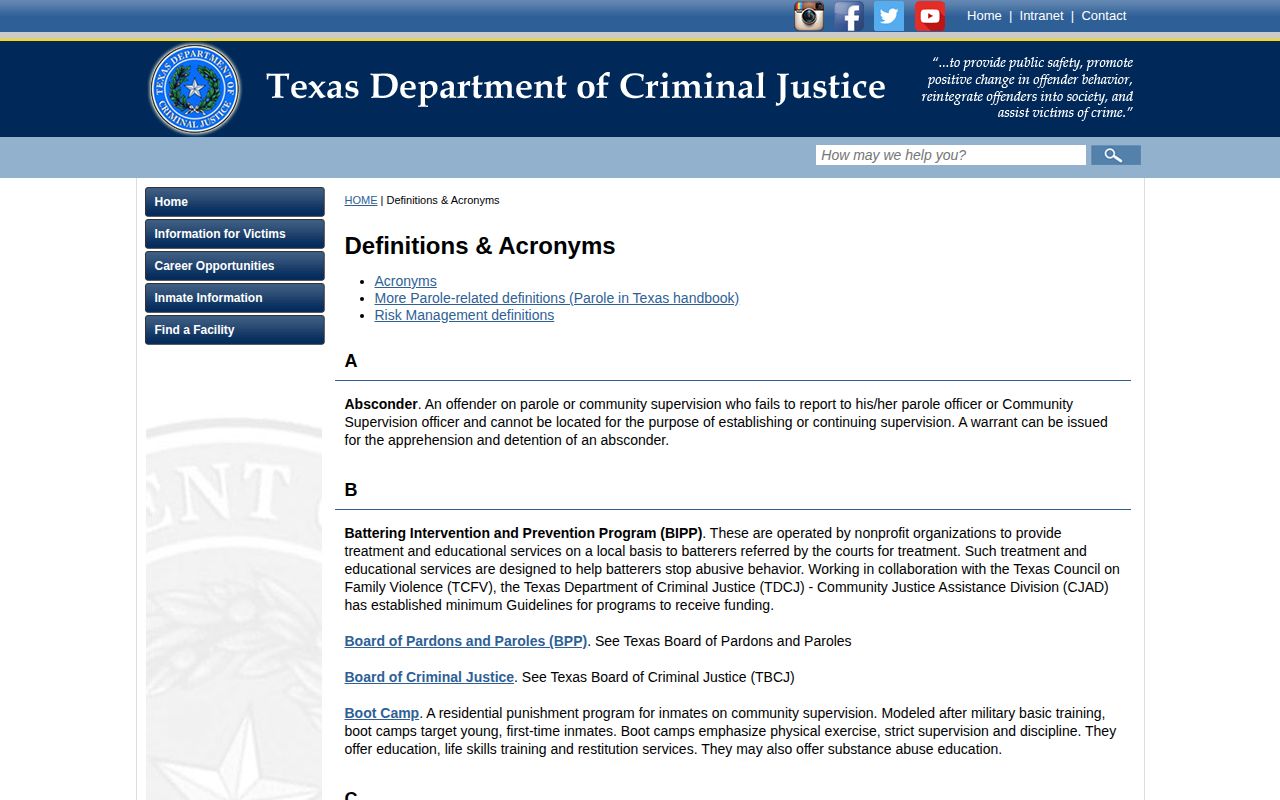
Interpret the field with its official definition, then use a completed event to confirm departure.
A VINELink release check can send an alert, but county IVSS and TDCJ IVSS are separate. Alerts may lag, so the facility remains the final source.
Brown County Date Source Map
Brown County contains several systems that can look alike in a search result. Brown County Jail is the adult local jail. Thomas R. Havins Unit is an adult TDCJ pre-release facility. Ron Jackson and The Oaks or Ray West are juvenile facilities whose identifying records have special confidentiality. Brownwood Police makes arrests but routes inmate inquiries to the county sheriff.
For a jail booking, begin with the sheriff's Released record. It supplies actual admit and release date and time, method, reason, court, charge, and agency. If the person is still in Current mode, there is no completed county release event to report. A displayed bond is context only. It becomes release evidence when paired with a completed timestamp and the record's release fields.
For Havins, use TDCJ even though the unit is physically in Brownwood. The term pre-release describes the unit mission, not an imminent date for every resident. Compare the person's TDCJ number, conviction county, offense, unit, and official date label. Call the unit when transportation depends on the schedule.
For a county sentence, obtain the judgment from the proper clerk. District criminal records generally route to the District Clerk, while county-level cases route through the County Clerk or County Court at Law. A docket setting is not a disposition, and a disposition is not the physical release timestamp. Pair court and sheriff records.
Brown Release Date Terms
- Eligibility date
- The first date on which a person may be considered under the applicable law, not a promised exit.
- Projected Release Date
- TDCJ's conditional forecast based on its records and calculation rules.
- Scheduled Release Date
- An operationally planned date that may still change.
- Maximum expiration
- The sentence-end date used when no earlier lawful release applies.
- Actual release
- The documented event when a particular custodian stopped holding the person.
Keep the exact agency label in notes and requests. Substituting “release date” for eligibility, review, projected, scheduled, or discharge can create a serious error. When two official sources differ, ask the records office which event each date represents rather than selecting the earlier date.
Request Brown Release Date Records
A precise request is more useful than asking an agency to calculate a sentence or answer when someone will get out. For the sheriff, identify the person and approximate booking period. Ask for the booking sheet, jail-history entry, admit date and time, actual release date and time, How Released, Release Reason, and public transfer destination. Request electronic, public, or redactable portions.
For TDCJ, include full name, seven-digit TDCJ number or SID when known, date of birth, and conviction county. Ask separately for Projected Release Date, Scheduled Release Date or Location if recorded, actual release or discharge date, type or status, and the public release documentation. Separating forecasts from completed events reduces ambiguity.
TDCJ PIA requests can use its online form, email, mail, or hand delivery. The research notes general copying at ten cents per page for smaller jobs, plus possible delivery, and added labor or overhead for larger work. An estimate above $40 requires a timely response. Costs and disclosure remain record-specific.
The sheriff's PIA poster likewise distinguishes inspection, estimates, deposits, and production timing. It does not guarantee every requested field is public. If the agency cannot produce releasable information within ten working days, it provides a reasonable availability date. Keep the request narrow and retain the response.
When planning transportation, ask which date the staff member is confirming and whether a release location has been set. Do not assume the listed unit is the departure point. Release processing can assign another location, and a hold can send the person to another custodian. Note the name of the office, the date of the call, and the exact label used. Recheck near the event because schedules can change without advance web notice. Afterward, obtain the actual release or discharge record so the forecast is not mistaken for proof.