
Brown Parole Versus Probation
Parole and probation both permit a person to live in the community under rules, but they begin in different ways. Parole follows confinement in a Texas prison or state jail. The Texas Board of Pardons and Paroles makes the release decision, and the TDCJ Parole Division supervises the person after release. Probation, formally called community supervision, is imposed by a court instead of a prison term or after a shorter jail term. Brown County Adult Probation, also called the local Community Supervision and Corrections Department, administers that court order.
A Brown County Jail record may show that a confinement episode ended, yet it does not by itself identify the full supervision status. A bond release can carry pretrial conditions without being parole or post-conviction probation. Use the judgment and the named agency to avoid mixing these categories.
| Question | Parole | Probation |
|---|---|---|
| Who orders it? | Texas Board of Pardons and Paroles | The sentencing court |
| Who supervises it locally? | TDCJ Parole Division, Brownwood DPO | Brown County Adult Probation |
| Best proof | TDCJ status plus Parole Division confirmation | Judgment plus Adult Probation confirmation |
| What release means | Prison custody ended, sentence supervision continues | Community supervision is part of the court sentence |
- Parole
- Conditional release from state confinement while the sentence continues.
- Probation
- Court-ordered community supervision, formally called community supervision in Texas.
- Discharge
- The agency-recorded end of a sentence or supervision term.
- Absconder
- A status determined by the supervising authority, not merely a missed contact or an absent search result.
Verify Brown Post-Release Supervision
Start with the system tied to the sentence. The TDCJ offender search is appropriate for a person committed to Texas state custody, including someone housed at Thomas R. Havins Unit. It is not proof that a person who bonded out of Brown County Jail is on parole. For probation, use the jail detail's court type and cause information to locate the judgment through the correct Brown County clerk, then ask Adult Probation to confirm public status.
- Identify the last custodian. Check the Brown County Released detail for a county stay or TDCJ for a state-prison case.
- Compare full name, date of birth, TDCJ or SID number, conviction county, offense, and court. Do not rely on name alone.
- For parole, read the exact TDCJ parole-review or status field. Contact Brownwood DPO or the TDCJ information channel with the identifiers.
- For probation, obtain the judgment or docket entry and contact Brown County Adult Probation. The parole office does not authenticate county probation.
- Ask only for information the agency can publicly confirm, such as supervision status and assigned office. Private residence and victim information may be withheld.
Brown County Supervision Offices
Brown County has an in-county state parole office, which makes the routing distinction especially important. The Brownwood District Parole Office is part of TDCJ Region V. It handles state parole and mandatory-supervision matters. Brown County Adult Probation handles supervision ordered by Brown County courts. Neither office should be treated as a general jail-release line.
Brownwood District Parole Office
907 Main Street
Brownwood, TX 76801
Phone: 325-646-0588
Fax: 325-646-0686
Brown County Adult Probation
Brownwood, Texas
Phone: 325-646-6475
Call to confirm the current office contact before a visit.
For a released-supervision or location question, TDCJ also lists io@tdcj.texas.gov. Board questions go to bpp-pio@tdcj.texas.gov. A request for public Parole Division records can go to pia@tdcj.texas.gov. State the exact record sought rather than asking the office to draw a legal conclusion.
The official Brownwood DPO listing is shown below. It confirms the local office and provides a source readers can recheck before making contact.
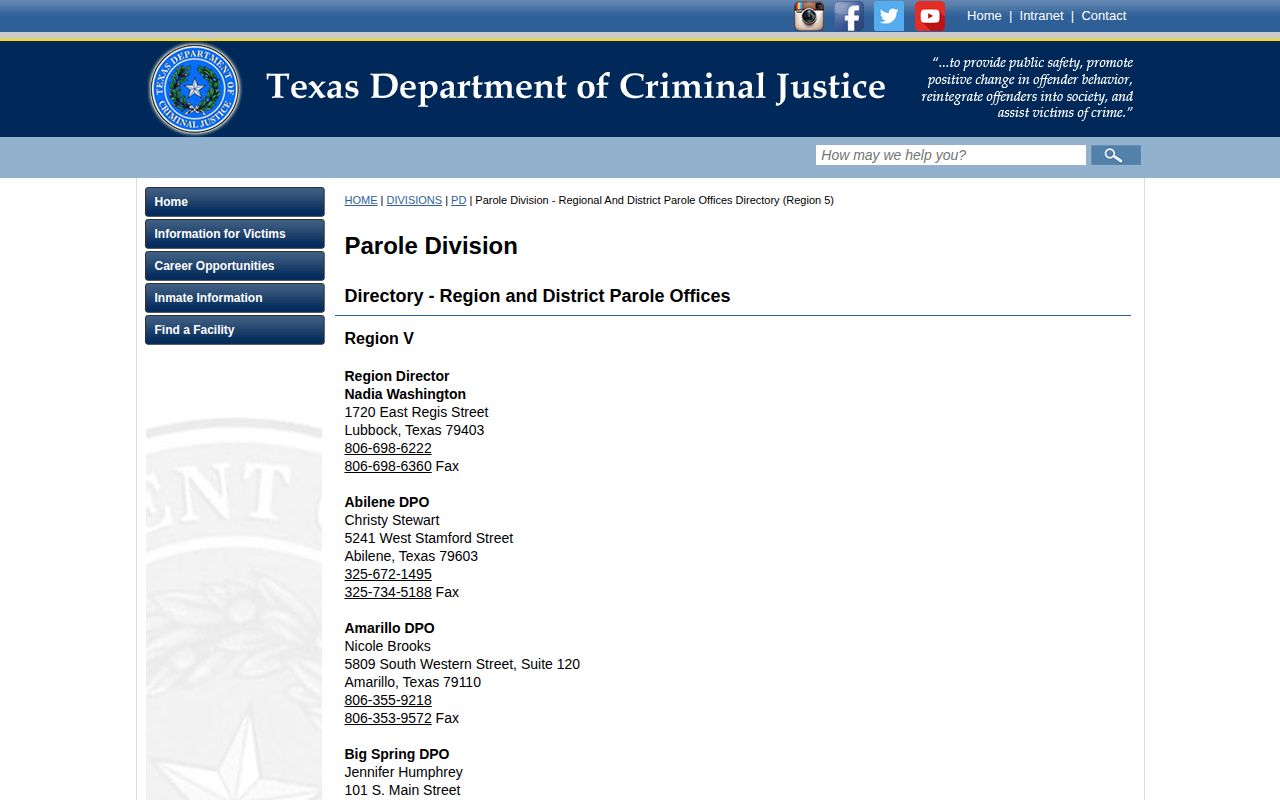
This office listing applies to state parole supervision, not Brown County court-ordered probation.
Brown Supervision Status Changes
Supervision can include reporting, residence, travel, treatment, program, or registration conditions set by the controlling authority. Exact conditions belong to the person's order and agency record. A violation allegation can lead to added review, a warrant, or revocation proceedings, but an allegation is not the same as a final finding. Likewise, a person who misses an appointment should not be described as an absconder unless the supervising agency or court confirms that status.
No official Brown County parole or probation absconder list was found in the research sweep. For public warrant or case status, contact the supervising office and the clerk that holds the case. Immediate wanted-status questions belong to law enforcement. Do not infer a warrant from a missing online record, and do not infer community release from disappearance from a custody roster.
Notification is also split by jurisdiction. TDCJ IVSS covers state-prison and parole events. County custody alerts use the current Texas IVSS-Counties route described on the Attorney General's victim-notification page. These systems supplement, but do not replace, direct confirmation.
Brown Parole Vote Is Conditional
A favorable Board of Pardons and Paroles vote is not proof that a person has physically left TDCJ. Review and Release Processing must complete the release-plan and eligibility work. Residence rules, discipline, required programs, special conditions, and registration criteria can stand between a favorable vote and actual departure. The official vote code matters. FI codes are favorable but may include conditions. CU/NR denies release and sets another review, CU/SA is a serve-all denial when permitted by law, and DMS denies discretionary mandatory supervision.
The BPP results guidance explains how to obtain a result. Its status line is 844-512-0461 and requires the person's name plus a TDCJ-CID number or date of birth. After a favorable vote, Review and Release Processing can address release status at 512-406-5202. Confirm later through an actual release record or event.
Ordinary parole review is file voting, not a conventional public courtroom hearing. Panel members review and vote individually, so no Brown County hearing calendar should be assumed.
Brown Supervision Discharge Records
Supervision ends when the controlling authority records completion, discharge, revocation, or another lawful disposition. The end date should come from that authority. A jail release timestamp proves only that one confinement episode ended. For parole, seek a TDCJ or Parole Division record. For probation, obtain the court's order and confirmation from Brown County Adult Probation.
Texas Government Code Chapter 508 governs parole and mandatory supervision, while Code of Criminal Procedure Chapter 42A governs community supervision. A completed county release can also be checked through the full Brown County released-inmate search path. Pairing the facility record with the supervision record answers both when custody ended and whether the sentence continued in the community.
When an online result is absent, submit a focused public-information request. Include the full name, date of birth, TDCJ or SID number if known, conviction county, and the specific status or discharge record sought. An absent search result is not proof that supervision never existed.
Keep copies of the agency response, judgment, and release record together. Each answers a different question, and no single missing web result resolves all three.
Before relying on supervision information, record the date and the office that confirmed it. Status can change after a violation, court action, discharge, or transfer of supervision. A dated agency response is clearer than an undated search note.