
Brown County IVSS Coverage
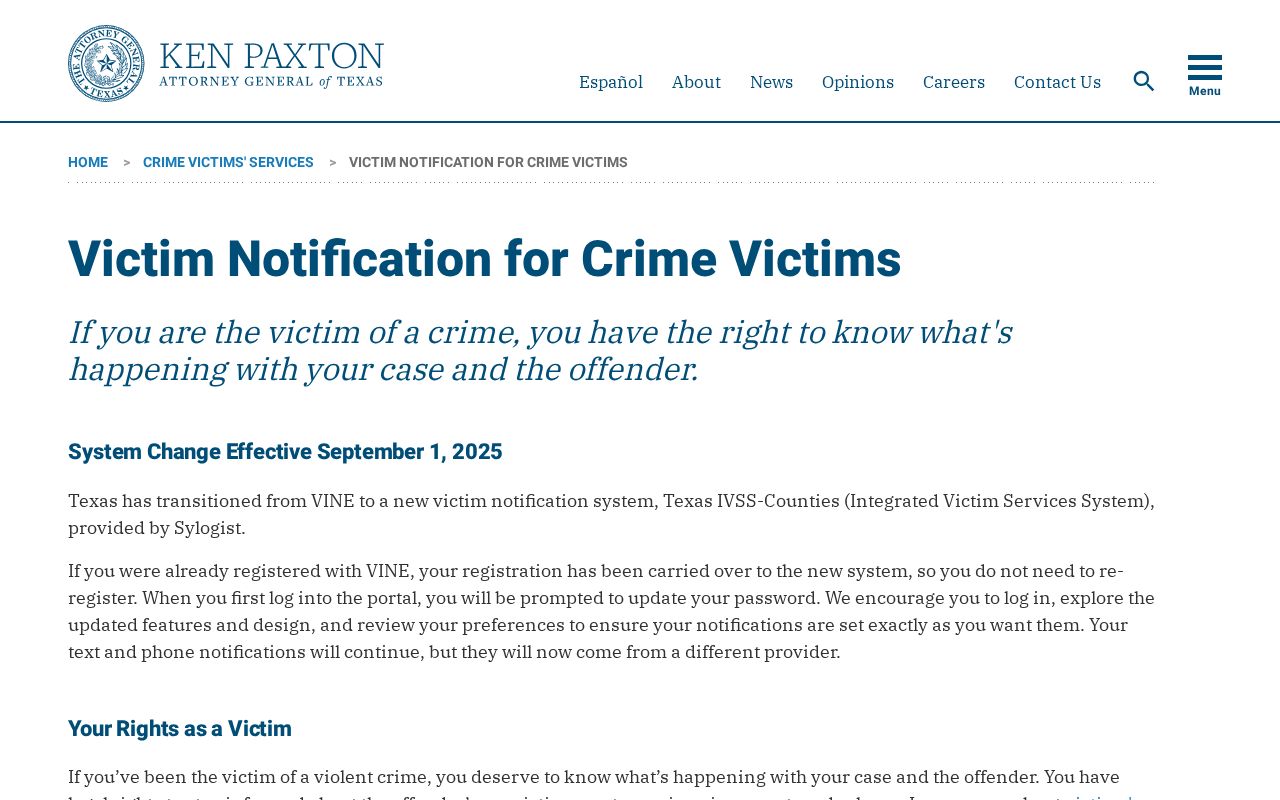
Texas changed county notification providers on September 1, 2025. The Attorney General says the state moved from VINE to Texas IVSS-Counties, migrated registrations, and asked users to update passwords. Brown County's sheriff page still points to VINELink. That old link shows notification intent, but it does not prove that legacy screens remain current.
Begin at the Attorney General's current notification page. Follow its county portal, confirm Brown County is offered, and use only the fields shown live. Research did not establish the replacement portal's PIN rule or released-result layout, so neither should be assumed.
The official transition page is shown below. It is the durable entrance when a stale sheriff link causes confusion.
County IVSS covers county custody events. TDCJ runs a separate system for prison and parole events.
Check One Brown County Person
A notification lookup is person-specific. Begin with enough details to separate people who share a name. Brown County's Released record can supply age, physical description, admit date, charge, court, arresting agency, and exact release time. Use those facts to evaluate a match.
- Open the Attorney General's page and follow Texas IVSS-Counties.
- Select Brown County if the current portal lists it.
- Enter the name and any identifier the portal requests.
- Open a match only after comparing available identity and agency details.
- Read the event label and timestamp, then confirm it with the sheriff.
If no match appears, check jurisdiction. A person at Thomas R. Havins Unit belongs in TDCJ, while a Brownwood Police arrest may appear in the county sheriff system. The Brown County released-inmate search supplies the full fallback route.
Brown Release Alert Fields
Field names depend on the current provider. Read each label literally. A custody-change alert can mean release, transfer, or another event, and those outcomes do not all mean community return.
| Field | How to use it |
|---|---|
| Name or identifier | Match it to the agency record. |
| Holding agency | Shows which custodian reported the event. |
| Custody status | Do not turn an absent result into release proof. |
| Event type | Distinguishes release from transfer. |
| Event time | Compare it with the facility record. |
Brown County's Released detail is stronger proof of the local episode because it provides release date and time, How Released, and Release Reason. A transfer value calls for a search of the receiving authority.
Register Brown County Release Notices
Registration must follow the choices displayed by the current IVSS-Counties portal. Former VINE instructions offered phone, email, text, and TTY notices and used a four-digit PIN for phone calls. Those are historical facts, not promises about the replacement service.
- Open the correctly matched person record.
- Choose the notification or registration action shown.
- Select only the contact methods currently offered.
- Complete the account, password, verification, or PIN steps displayed.
- Save the registration confirmation and preferences.
Existing VINE registrations were migrated, but users were prompted to update passwords. Check a prior registration instead of assuming it works. Delivery can lag, and a missed alert does not prove custody stayed unchanged.
Brown State Release Notifications
TDCJ IVSS covers state-prison and parole events. Notices can concern parole decisions, bench-warrant movement, prison release, or discharge. The service lists 800-848-4284 and victim.svc@tdcj.texas.gov.
This split matters because Havins Unit is a TDCJ pre-release unit in Brownwood, not a county jail. Search the TDCJ offender system and register separately. TDCJ says its public data is updated on working days and is at least 24 hours old.
The official TDCJ IVSS portal appears below.
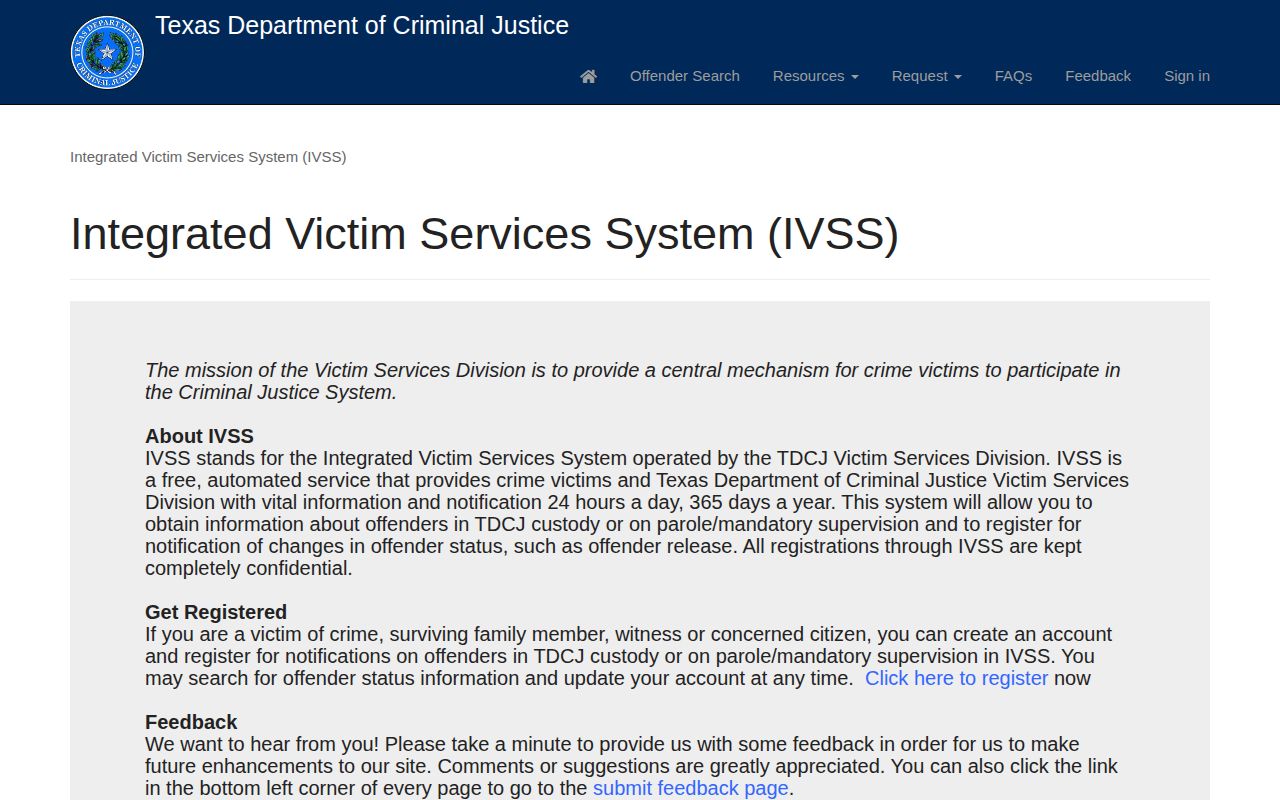
One registration does not automatically cover both the county and state systems.
Confirm Brown County Release Alerts
IVSS does not replace the sheriff's completed record. Read the exact release time, method, and reason. For TDCJ, distinguish a projected or scheduled date from actual release or discharge.
Federal cases need another channel. The BOP locator covers federal custody, while ICE's locator has limited recent-release coverage and USMS lacks a similar historical locator. County IVSS should not be presented as covering them.
If Brown County participation cannot be confirmed or the portal fails, call the jail at 325-641-2481 or request the identified booking's release fields from sheriff.records@browncountytx.gov. A failed search is not a negative finding.
Brown County Alert Fallbacks
The Brown County sheriff application contains separate Current and Released modes. A person who has left the jail will usually drop from Current, so an IVSS search should be checked against Released rather than treated as a current-roster lookup. The list gives name, age, sex, race, admit date, release date, and time in jail. Responsive data adds court type, primary charge, and arresting agency.
Open the detail for stronger proof. It adds exact release time, How Released, Release Reason, confining agency, physical descriptors, photo, and charge or bond data. A completed timestamp plus street or bond language is strong evidence that the county stay ended. A transfer value means the search must continue with the receiving system.
The sheriff publishes no fixed refresh cadence. A new event may reach one system before another. If timing matters, call the jail, preserve the alert, and request the release record. For a court disposition, use the court type in the jail detail to route the case to the District Clerk or County Clerk. A court order can explain the legal outcome, but it does not alone prove the exact minute jail processing finished.
Notification services also have privacy and coverage limits. Search only for a properly identified person and do not assume that every event or every old record remains online. The prior county VINE material described a limited post-release period, while the new provider's retention was not verified. An older absence belongs in a records request, not in a conclusion that no booking or release occurred.
Access Brown County IVSS
The roster wrapper and inner application may behave differently in a browser. The official sheriff page establishes provenance, while the inner application supplies the records. A certificate or mixed-content warning at the wrapper does not make a commercial lookup a sound substitute. Use the direct sheriff-linked application when needed. Keep the jail telephone and written-request route available if the official interface is down. Record the exact source, event label, and access date when preserving an alert because provider screens and generated links can change.
Read Brown County Custody Events
A county custody event is facility-relative. “Released” means Brown County Jail stopped holding the person, but the destination can be the street, another jail, TDCJ, federal custody, immigration custody, or another authorized placement. Read How Released and Release Reason before describing what occurred. A transfer is not community return.
A state notification also requires care. Parole means physical prison confinement ended while sentence supervision continued. Discharge has a different meaning and should be reported only when TDCJ uses that status. A parole eligibility date, favorable vote, projected date, or scheduled date is not the same as actual release.
Identity checks matter when names repeat. Compare age, physical descriptors, booking or offender number, admit date, offense, court, conviction county, and reporting agency. Do not combine two records just because they share a name. If fields conflict, ask the custodian to clarify the specific event.
Preserve a useful notification with its date, channel, and event text, then seek the source record. For Brown County, request admit and release date and time, method, reason, and public transfer destination. For TDCJ, request public incarceration history, actual release or discharge date, and release type. This produces a durable answer even if an alert later disappears.
Keep contact preferences current after registration. A changed phone number, blocked text, full mailbox, or outdated password can prevent delivery even when the agency sends an event. Check the account through the current Texas portal and use the official support contact when a confirmation cannot be found. Never depend on one notification channel when a release has urgent personal or court-related importance. Pair the alert with direct facility confirmation and retain the completed release record.